True to form, I played a lot of games last year. I didn’t quite carry through on my goal to play the classics primarily but I’m super glad I had the chance to play some of these gems from this year!
Last Thursday (our typical game night), instead of fireworks and flags, we took advantage of the release of Super Mario Maker 2 to host a little game jam! Ever since the original Mario Maker on Wii U I’ve had fantasies of having little game jams where we all create level designs with some constraints. For our initial attempt at a jam, we gave three randomly-assigned traits (game type, level type, style) to each participant and broke for an hour to create levels.
Once the timer sounded, we uploaded and validated our creations and took turns trying them out. Below are each of the levels and their codes:
My love of gaming started early and still burns bright, even if my relationship with it is a little weird right now (feeling pushed out of the AAA scene via boredom). Last year, I kept a quick ranking of every game I touched by enjoyment and thought I’d write a little about my favorites.
Honorable Mentions
Donut County: The game design is a bit simplistic but it’s an ear-to-ear grin inducer from start to finish with wonderful characters, snappy, aware writing, playful graphics, and a soul that exudes joy. And raccoons.
Deltarune: Who would have thought we were going to get a fully functional and super enjoyable first act to a sequel to Undertale out of the blue? Great music, interesting new characters and nostalgic hooks made for a really fulfilling experience and gave way to the excruciating wait for the final product someday, hopefully.
Forza Horizon 4: I’m actually kind of bummed that this didn’t make my top five, but the changes to the world economy and introduction of extremely silly personalization options really took me out of the perfect formula the team crafted for the previous iteration. That aside, the game is still one of the best racing games ever made and a wonderful co-op experience that shouldn’t be missed.
Here’s a music video / clip reel of my favorite game announcements, trailers, and gameplay from E3 2018! I used to make a point to make one of these every year but it dropped off many years ago. After a really thrilling set of reveals (and the sad state of world), I decided to dust off the process and take on the simple creative exercise.
The whole process is so enjoyable: finding the game trailers I love, selecting the perfect song for the mood I want to impart, extracting the most thrilling video clips, creating a beat track to align the clips, arranging everything…it feels awesome to feel a clip slide right into place with the music. A couple nights of that and some polish and viola, a little time capsule of my mood, interest and excitement bundled into one hype reel.
Even if these games never live up to the hype (or come out at all), I’ll always love a good E3 trailer. Enjoy!
Join me on a journey back through one of my favorite video game experiences: Riven: The Sequel to Myst! Watch at 1.5x, and don’t miss my previous Myst Retrospective: https://www.youtube.com/watch?v=zp1jkGEKnCU
Despite being one of my favorite game series ever, I dropped off the Myst train after Myst 3. In an attempt to get back on and get some motivation to see through Myst 4 and 5 (and maybe Uru) before mainlining Obduction, I wanted to revisit Myst, Riven, and Exile and share my thoughts in some form.
The above video is my attempt for Riven, which featured a whole webcam just for my notes! I had a ton of fun with this one; it’s so much harder to related the game through a thorough playthrough (as the puzzles and world are much less modular than Myst). Enjoy!
Join me on a journey back through one of my favorite video game experiences: Myst! I talk about Myst, why I did this video, why Myst is special, and then I skate through all of realMyst: Masterpiece Edition! Save yourself some time and watch at 1.5x.
Despite being one of my favorite game series ever, I dropped off the Myst train after Myst 3. In an attempt to get back on and get some motivation to see through Myst 4 and 5 (and maybe Uru) before mainlining Obduction, I wanted to revisit Myst, Riven, and Exile and share my thoughts in some form. The above video is my attempt for Myst. The Riven video is being edited and is coming soon!
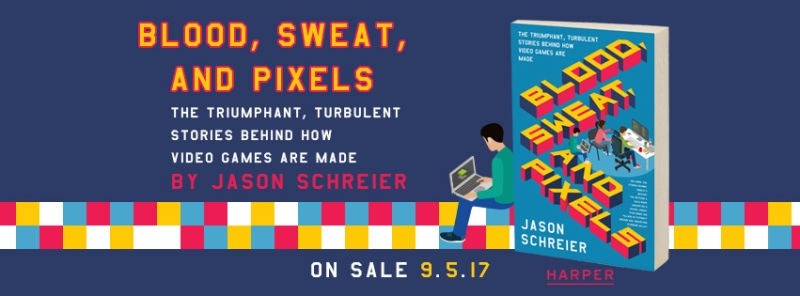
Jason Schreier (kotaku.com), a veteran of the video game beat, weaves together several historical narratives from primary sources that describe in often-painful detail the difficulties most every game befalls on its way to launch, from the single-man production of Stardew Valley to the large-team blockbuster Uncharted 4.
The writing is approachable for non-enthusiasts but fills in knowledge gaps for even the most well-read fan. The chapter on Destiny is particularly special, building on the success of Kotaku’s excellent reporting to finally bring the details of that game’s late-stage reboot together into one coherent (if maddening) story.
The book left me with a renewed desire to check out The Witcher 3, another reason to dislike George Lucas, and a much healthier respect for the kinds of experiences Kickstarter enabled. Having lived through and managed a number of product launches over the past decade (though none nearly as intense), these chapters stoked memories of ownership conflict, poor management decisions, troublesome tooling, and the intense ups and downs of being a cowboy coder. The common thread of “crunch”, of working yourself to the bone to finish even somewhat on time, was all too familiar, and the picture Schreier paints of it being an almost essential ingredient in game development is simultaneously tragic and human.
It’s not entirely about failure, though. It was likewise a real treat to read about the Diablo 3 team consoling a downtrodden Destiny team after launch woes, showing how common some of these growing pains can be even from teams with radically different pedigrees. These stories, while bleak, are just as much about turning a lonely coder into a multi-millionaire and allowing a team of burned out and bored friends to risk it all and strike gold.
There’s a fairly ubiquitous quote by Shigeru Miyamoto: “A delayed game is eventually good, but a rushed game is forever bad.” Blood, Sweat, and Pixels shows that in today’s industry, any finished game at all is a special thing. Highly recommended.
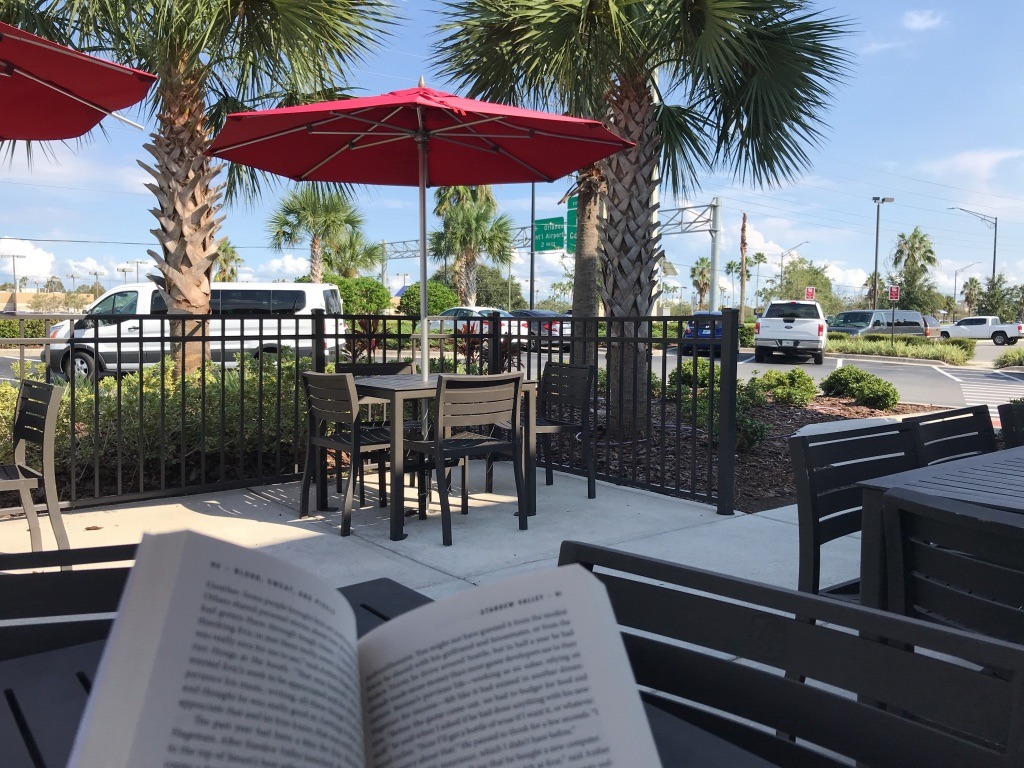
I digested a good chunk of this in the shade of a local Chick-fil-A. It’s amazing how quickly things return to normal after a major hurricane. I’ll miss this about Florida one day, I’m sure.
The games I’ve been playing have been piling up in my “to review” queue, so let’s flush that queue with some mini reviews! This is also a wonderful distraction from our collective impending doom at the hands of Hurricane Irma.
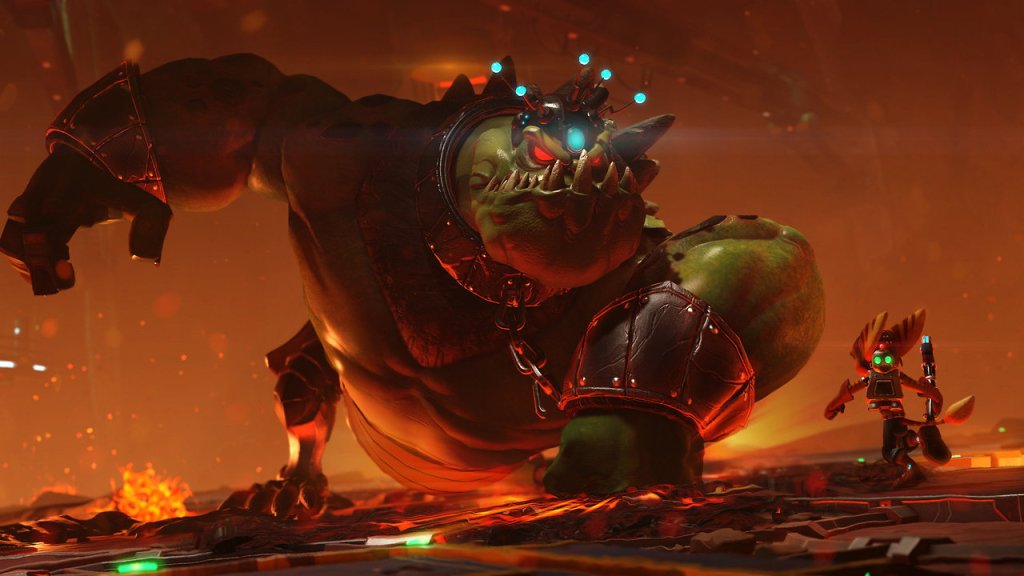
Ratchet and Clank (PS4): Damn near perfect remake. Looks absolutely drop-dead gorgeous (and somehow even better on a PS4 Pro), controls fantastically, has plenty of compelling, fun progression and exploration hooks, and is loaded with diverse, playful weapons and tools. It’s an absolute must-buy for any PS4 owner.
Sly 2: Band of Thieves (HD Collection, PS3): On my continuing quest to be better informed about raccoon video game history, I recently finished the main story in Sly 2. The game, like its predecessor, offers smooth framerates, tight controls, and somewhat-muddy cel-shaded graphics. This iteration adds more playable characters and attempts more one-off mechanics, mini-games, and scenarios, and really doesn’t seem much better for it. Each game world is now an “open” world, which really just adds padding time of having to walk to each mission and little else. There’s still unskippable cutscenes and tutorials, atrocious turret controls, unnecessary upgrades, and the artifact of PS2-era character-driven platformers. It’s sad that these early 3D games that pushed the envelope are going to fall apart over time, but I’m glad the HD collection exists. I know this game is old, and feels like it would have been the best thing out there when it first came out. Recommended for raccoons and video game historians.
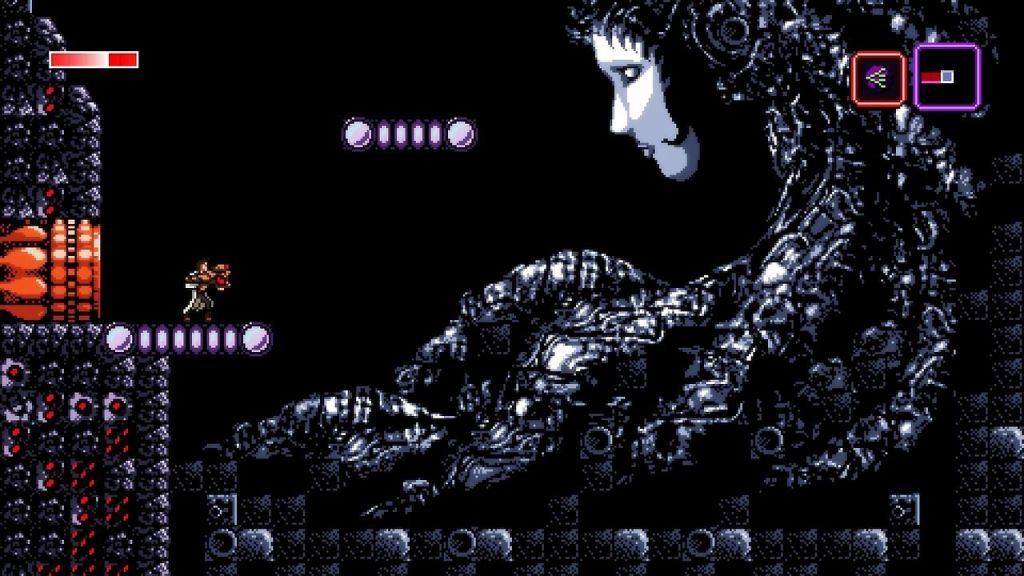
Axiom Verge (PS4, Vita, XB1, Wii U, PC): A Metroid clone that is too much Metroid and not enough Super Metroid. The game stands on its own with a decent story, interesting world, and lots of diverse weaponry to track down and utilize, but it leans on too many of the outdated, hardcore mechanics and traditions of the original, NES Metroid. Environments are forgettable, bland, repetitive, and often indistinguishable. Character movement is slow, every enemy encounter can be deadly, but the game requires lots of mindless backtracking and aimless wandering. Death is very painful (and annoying) when traversal isn’t fun. It was more fun on subsequent playthroughs for trophy hunting, but it’s hard to recommend to anyone outside of die-hard retro Metroidvania enthusiasts.
Risk of Rain (PS4, Vita, PC): I was a little late to this party, but thanks to Toya and Riloh, our household got a bit addicted to this marvelous little rogue-like. The pixel-art style is fantastic (it’s still my MacBook’s background). The characters and power-ups offer an exciting and insane amount of customizable and randomized variation (maybe too much). But the music is perhaps the best part and had me humming for days after each hours-long play session (a game is somewhere between 10 and 60 minutes).
It’s gamer Christmas again! With the Microsoft press conference about to kick off (5pm EST; larger schedule here), I wanted to jot down some personal hopes and dreams for possible announcements during the week:
A PS4 port of PixelJunk Monsters. It’s really just unfair at this point.
Nintendo, give us a truly stellar 2.5D Metroid game. Zero Mission is about as close as we’ve gotten to a Super Metroid-caliber
release, but even it was a little heavy-handed with the direction and a
touch too linear for my taste. I’d also take a Metroid Prime Triolgy
Switch port, or a new entry in the series.
If we can’t have Metroid (not holding my breath), at least let’s get an MS announcement for Shadow Complex 2.
I enjoyed Resident Evil 7 more than 5 and 6, but I’d really like to see some news on a traditional RE game. The RE2 remake is in the pipeline somewhere, but really anything in the vein of the GameCube REmake would be fantastic.
We’re getting some premium new hardware from Microsoft, so I expect we’ll see a matching price drop for the PS4 models (and maybe the PSVR?). I would love to see Scorpio land around $400, but it’s really unlikely for the kind of powerful machine they’re producing. If they settle on $500, hopefully the pack-ins will make up for the higher sticker price.
With HD remakes popping up all over the gaming landscape, I wouldn’t mind seeing another game redone in the Ratchet and Clank series. The PS4 variant of the original is one of the best games on the system, and I’d love to see similar efforts for the other good games in the series.
I would die to play Mario Galaxy or Mario Sunshine on the Switch. Port those suckers. Or really, you know, anything more about the Switch. Maybe a true Pokémon game? F-Zero? Even old SNES-era Final Fantasy ports would be okay (since there are already iOS variants).
It feels like it’s flown under the radar a bit, but a Below release date for Xbox One would be excellent. Cannot wait to check that out!
A new Alan Wake game, or at least a UHD re-release of the original with DLC. I would take any excuse to replay that game, and what better way than on Scorpio in 4K?
A true Banjo-Kazooie sequel? Yooka-Laylee had the hype train behind it but ultimately left a pretty sour taste in my mouth, mostly because it wasn’t as good as the original inspiration (even today). A long shot, but hey, Microsoft probably still owns the IP!
What ever happened to that ReSpawn Star Wars title?
Obduction port for consoles? I’m grasping here.
I hope we don’t hear anything about Death Stranding. In an age where Fallout 4 was announced months before release, enough with the news on games that haven’t even been designed yet.
It’s pretty overcast and rainy here in Florida–perfect weather for an afternoon of E3 press conference watching! It’s hard to explain how excited this time makes me; there’s so much possibility in the air, and the bombast and spectacle of it all is really energizing.
I’ll try to blog some post-E3 thoughts as well.
I hope everyone see’s something checked off on their own wish list, and have a great E3!
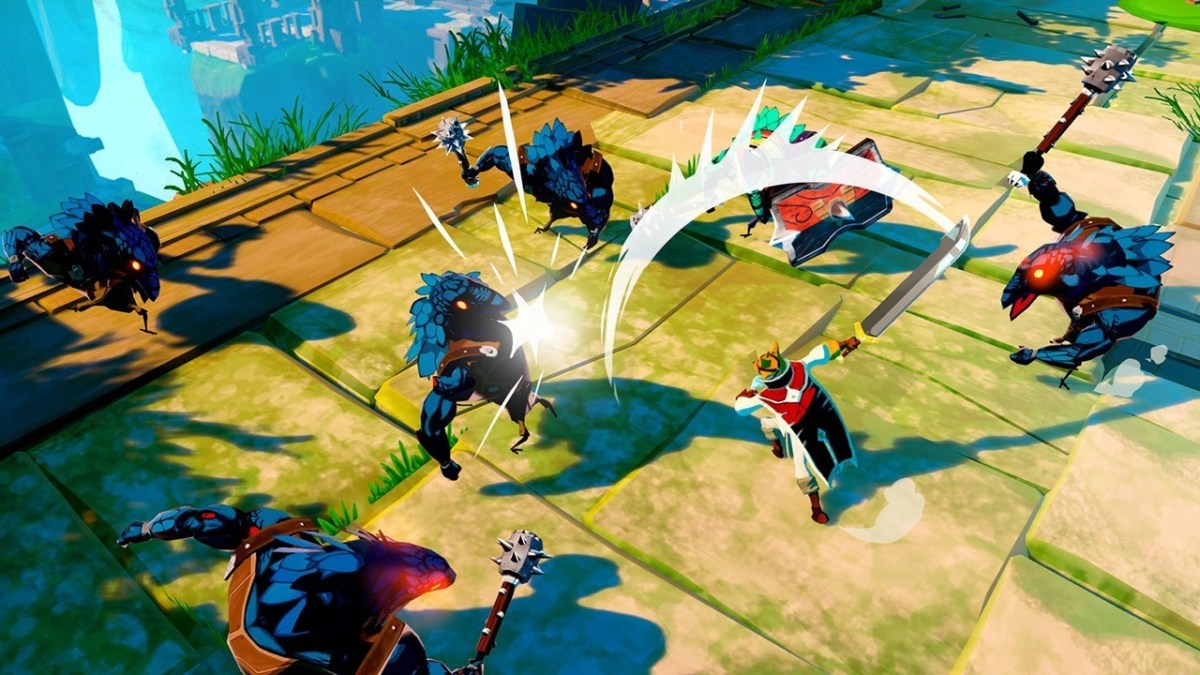
Reynardo, Reynardo, what has thou donst (besides stolen my heart). Stories: The Path of Destinies is a brief but enjoyable hack-and-slash RPG that wraps simple-but-compelling combat, progression, and story mechanics into a bundle largely elevated by fantastic art direction and unique storytelling.
This action RPG sets itself apart by providing all the basics along with its uncommon approach to storytelling. The standard systems are here: snappy, fun combat; upgrades throughout; different weapons, enhancements, and techniques; and light exploration with crafting loot as a reward. Layered on top of this well-executed mindless fun is a choose-your-own-adventure narrative with all characters voiced by a single actor, lending a fairy tale aesthetic to its wonderful cutscenes and omnipresent narration. Characters are enjoyable, quipping at each other with an endearing rapport. The obvious love and polish coating the more basic elements of the game were more than enough to draw me into the world and story the creators wanted to tell, and the oddly-satisfying combat and systems kept me hooked well beyond the culmination of the main arc.
Each choice made in the story funnels the player to different worlds and outcomes, with each ending uncovering a “truth”. This truth is intended to help steer future choices closer to the critical path, with each play-through uncovering more and more until the “true” path is completed. It’s a fantastic and interesting mechanic; I just wish there were more “truths” to uncover and that I hadn’t found the critical path as quickly as I did.
The art throughout is amazing. Each gameplay sequence is book-ended by these emotive, lithograph-stye illustrations depicting Reynardo, the swashbuckling, dreamy, confident hero fox, adventuring into his fantasy world. The character icons accompanying subtitled narration smile, frown, and smirk while the narrator layers bedtime-story inflections over each one. Each world is bathed in color and style, and while most are short (each five-world playthrough is 20-30 minutes long), each defines itself with a unique palette and aesthetic. The blow-by-blow swordplay is accented with explosive particle effects and time slowdown, delighting visually as it does functionally. The visuals and voice work elevate Stories from good to fantastic.
There are some (but few) sour notes. Load times are long and frequent. The game suffers (at least on PS4) from some fairly major pop-in problems, both for textures and in some cases entire slabs of geometry, forcing me to navigate blindly to the next piece of the level. These minor issues never seemed to detract from the enjoyment, however.
The game design also seems to fizzle out past several playthroughs, despite the game’s hook being the intentional repetition of its story. While having tens of endings, individual choices don’t alter much of the story thread or have a large impact on the gameplay. It’s hard to knock the game too much for this, though; it seems to know it only works for as long as it needs to, and that’s mostly fine. Just know if you plan to grind out every achievement and ending, the mechanics will likely lose their appeal.
In all, Stories is just about a perfect package of RPG junk food, and I mean that in the best way possible. It’s charming and original while keeping things short and to-the-point. Highly recommended for anyone looking to have some highly-polished dumb fun.